2026 Operational Resilience AI Tooling Panorama
Published April 21, 2026
- Cybersecurity

Key takeaways
- Our 2026 OpRes AI Tooling Panorama analyzes the new wave of AI powered vendors, assessing their AI maturity, functional capabilities, and the value they deliver across the resilience ecosystem.
- 89 AI-driven resilience vendors were reviewed across 6 functional categories and 3 levels of AI maturity
- This edition reveals significant progress in AI integration across resilience capabilities, evolving from basic chatbots to autonomous agentic systems
The operational resilience AI tooling panorama

AI maturity level
The methodology
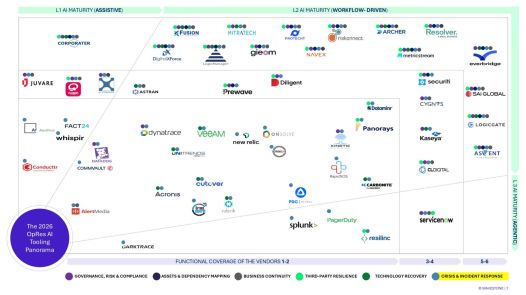
The 2026 Operational Resilience Tooling Panorama analyzes 89 global vendors offering Operational Resilience AI Tooling. Each vendor is categorized to 6 operational resilience functional areas and mapped to 3 maturity tiers, based on the AI use cases offered.
It can be used to illustrate how AI is embedded across tools (i.e AI use cases), where functional overlaps exist, and the maturity of AI capabilities to help you make informed procurement decisions.
| 6 functional categories | 3 AI maturity tiers |
|---|---|
|
|
2026 Operational Resilience AI Tooling Panorama by functionality
Scroll through the tooling panorama below to see the filtered view of vendors in each of the 6 functional categories.
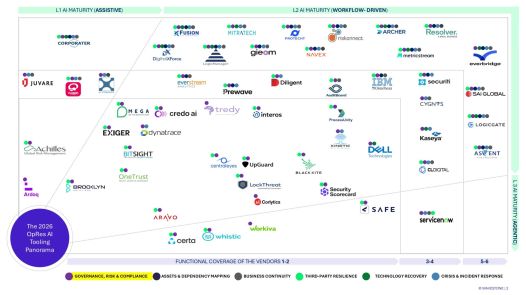
Vendors filtered offering governance, risk & compliance
This chart highlights the governance, risk & compliance segment of the 2026 operational resilience tooling landscape, showing how AI scans regulatory change, maps requirements to controls and policies, and identifies compliance gaps more efficiently. It also highlights capabilities in audit‑trail automation, executive dashboards, and risk quantification, enabling real‑time oversight and data‑driven regulatory decision‑making at scale.

Vendors filtered offering assets & dependency mapping
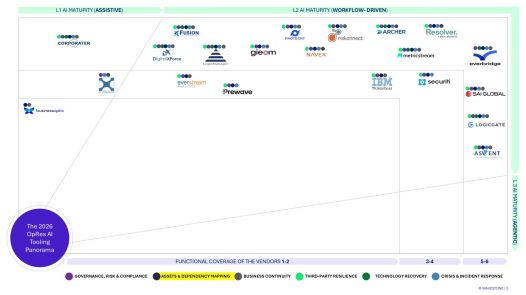
This chart focuses on assets & dependency mapping vendors, showing how AI automatically discovers processes, assets, and services while maintaining end‑to‑end dependency maps. It also highlights capabilities to identify important business services and model failure propagation, enabling detection of high‑risk dependencies and hidden concentration risks across the ecosystem.

Vendors filtered offering business continuity
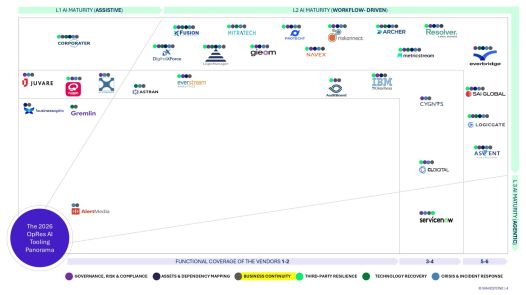
The business continuity segment shows how AI accelerates business impact analysis and business continuity plan generation through intelligent search, summarisation, and analytics. It also demonstrates AI‑driven scenario planning and testing, enabling realistic exercises, performance evaluation, and gap identification against recovery objectives.

Vendors filtered offering third party resilience
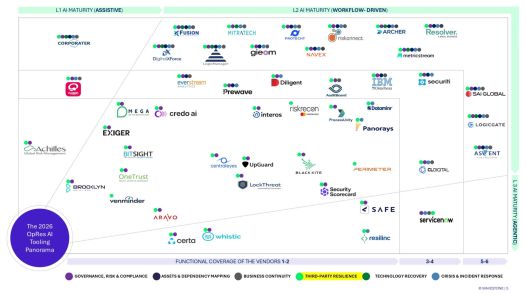
In this segment, AI is used to monitor supplier risk signals, map supply‑chain dependencies and detect concentration and systemic exposures. It also highlights contract intelligence and lifecycle management, enabling automated evidence collection, vendor tiering and real‑time risk scoring.

Vendors filtered offering technology recovery
This chart highlights the technology recovery segment of the 2026 operational resilience tooling landscape, showing how AI strengthens disaster recovery assurance by identifying gaps and keeping recovery objectives within impact‑tolerance thresholds. It also highlights intelligent recovery sequencing and simulated DR testing, enabling optimal restore decisions, bottleneck detection, and faster, more reliable recovery.
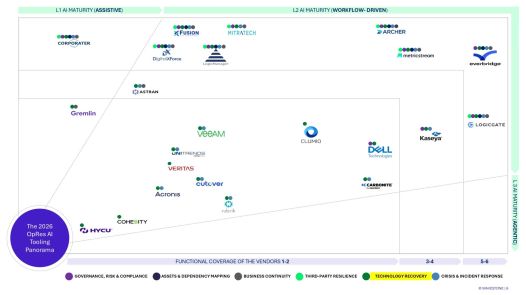

Vendors filtered offering crisis & incident response
AI is used to enhance incident management end‑to‑end through intelligent prioritisation, event correlation, and investigation. It also demonstrates AI‑driven playbook execution and crisis communications, enabling guided response actions, real‑time situation reporting, and faster, more coordinated decision‑making during live incidents.

What to expect from the tooling panorama:
Panorama: The visual provides a snapshot of the AI Operational Resilience tooling market, illustrating the functional categories and the vendors maturity levels.
In Depth Report: In-depth analysis of the three AI maturity tiers, insight into the 4 tooling trends detailing powerful market shifts and distinct pattern of vendors’ functional capabilities and AI maturity reveal. The report concludes with the steps your organization must take to adapt to the changing landscape to help you make informed procurement decisions.


