Agentic AI study: From GenAI to Agentic AI in Financial Services
Published July 9, 2026
- Banking
- Data & AI

This study examines how banks and insurers are moving from Generative AI to Agentic AI and what organizational, governance, data, and operating-model changes are required to scale AI successfully across the enterprise. It is based on 30 semi-structured interviews with senior leaders from banks, insurers, and technology providers in the DACH region, conducted jointly by Wavestone and the University of St. Gallen between October 2025 and May 2026.
Key takeaways
- Agentic AI has moved beyond the hype: Financial institutions increasingly view Agentic AI as a strategic capability with the potential to transform operations and customer engagement.
- Regulation remains the primary adoption barrier: Compliance requirements, governance expectations, and regulatory uncertainty continue to slow implementation efforts.
- Organizations are prioritizing high-value use cases: Current initiatives focus on areas where automation, efficiency, and decision support can deliver measurable business outcomes.
- Governance will determine scale: Successful adoption depends on robust governance frameworks that balance innovation, risk management, and regulatory compliance.
- Early movers are building competitive advantages: Organizations that establish capabilities, operating models, and expertise today are positioning themselves for long-term differentiation.
The current state of Agentic AI
Agentic AI is rapidly moving from experimentation to implementation. Financial institutions across banking and insurance recognize its potential to automate complex processes, enhance decision-making, improve customer interactions, and unlock productivity gains at scale. Yet despite growing interest, most organizations remain in the early stages of adoption.
The challenge is no longer understanding the technology itself. Instead, organizations are navigating a complex landscape of regulatory requirements, governance expectations, legacy systems, and risk management considerations. As a result, many institutions are carefully balancing innovation with compliance while identifying practical use cases that create measurable business value.
Our study explores where financial services organizations currently stand on their Agentic AI journey, which barriers are slowing progress, where value is already being generated, and how leading organizations are preparing for the next wave of AI transformation.
We process personal and highly sensitive data here. Technically, it’s not the problem, but the regulatory effort, the AI Act, GDPR, DORA – that’s where the biggest limitations are.
Get a glance at the study
Structure of the study
The Agentic AI study is structured along the key dimensions that determine how financial institutions can move from isolated AI use cases to an agentic operating model:
- Executive summary: Overview of the current state of agentic AI in financial services, key blockers, operating-model implications, and strategic recommendations.
- Introduction & strategic context: Examination of the forces shaping AI adoption, including demographic change, cost pressure, regulation, legacy systems, and the emergence of agentic AI as a new paradigm.
- Current state of financial services: Analysis of AI maturity across banks and insurers, covering machine learning, GenAI adoption, agentic AI readiness, and the organizational factors that differentiate leaders from laggards.
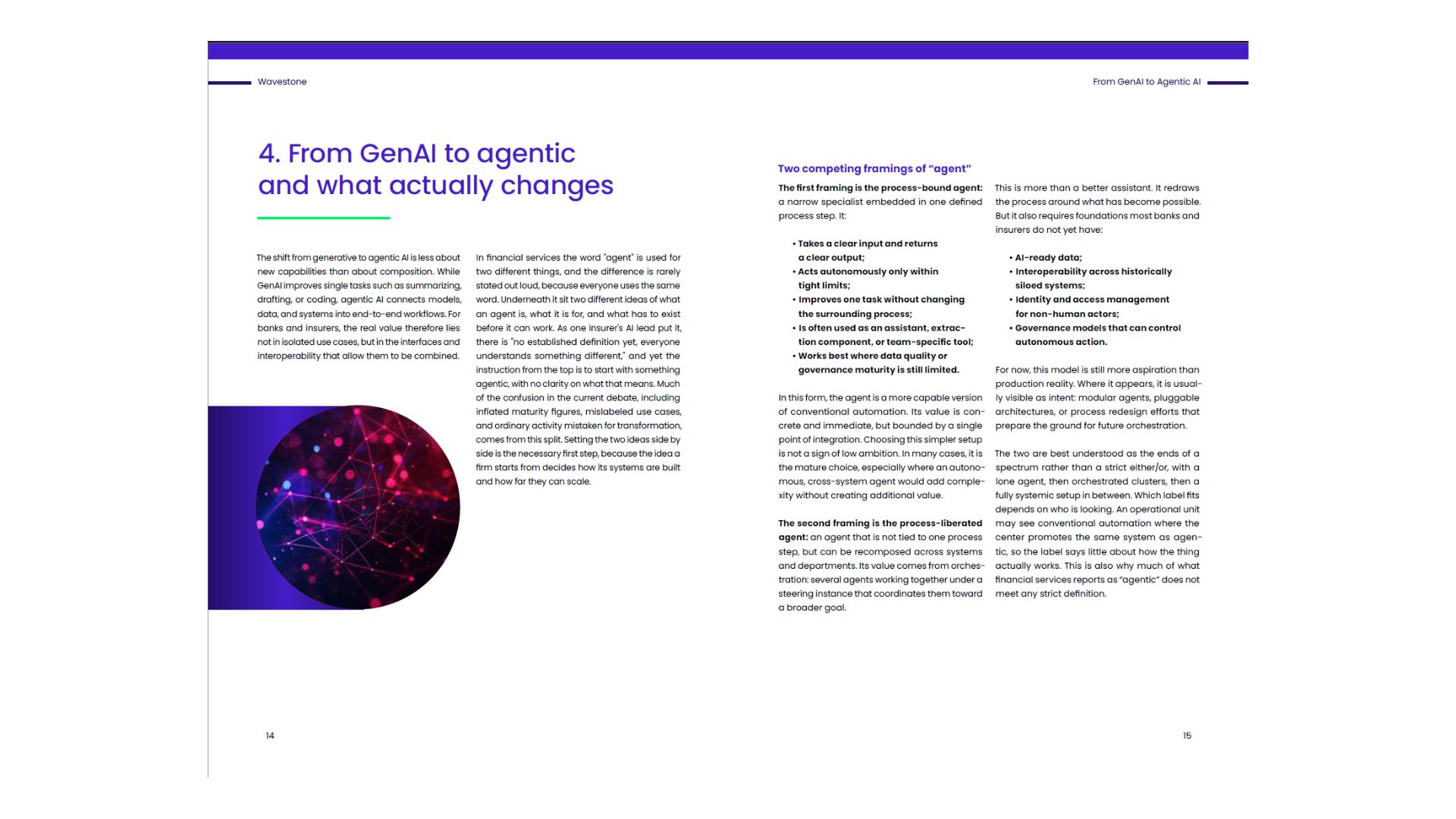
- From GenAI to Agentic AI: Exploration of what truly changes when moving from task-based AI to orchestrated, end-to-end workflows, including agent architectures, orchestration principles, and scalability requirements.
- Key blockers to adoption: Assessment of the main barriers to scaling agentic AI, ranging from regulation, compute capacity and sovereignty concerns to data quality, governance, workforce readiness, and legacy technology.
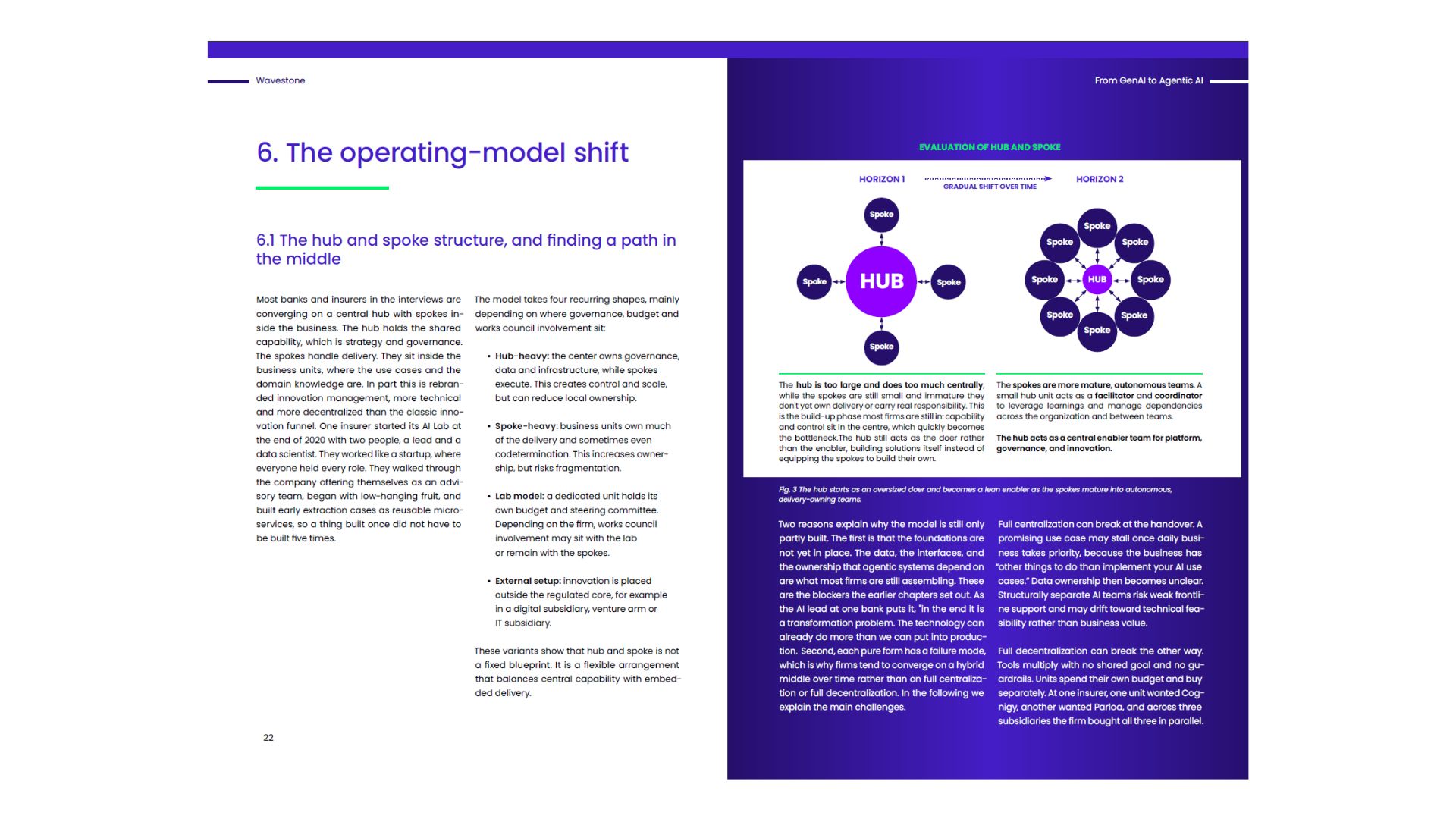
- The operating-model shift: Deep dive into the target operating model, including hub-and-spoke structures, AI strategy, governance, portfolio management, and the evolving role of IT and business functions.
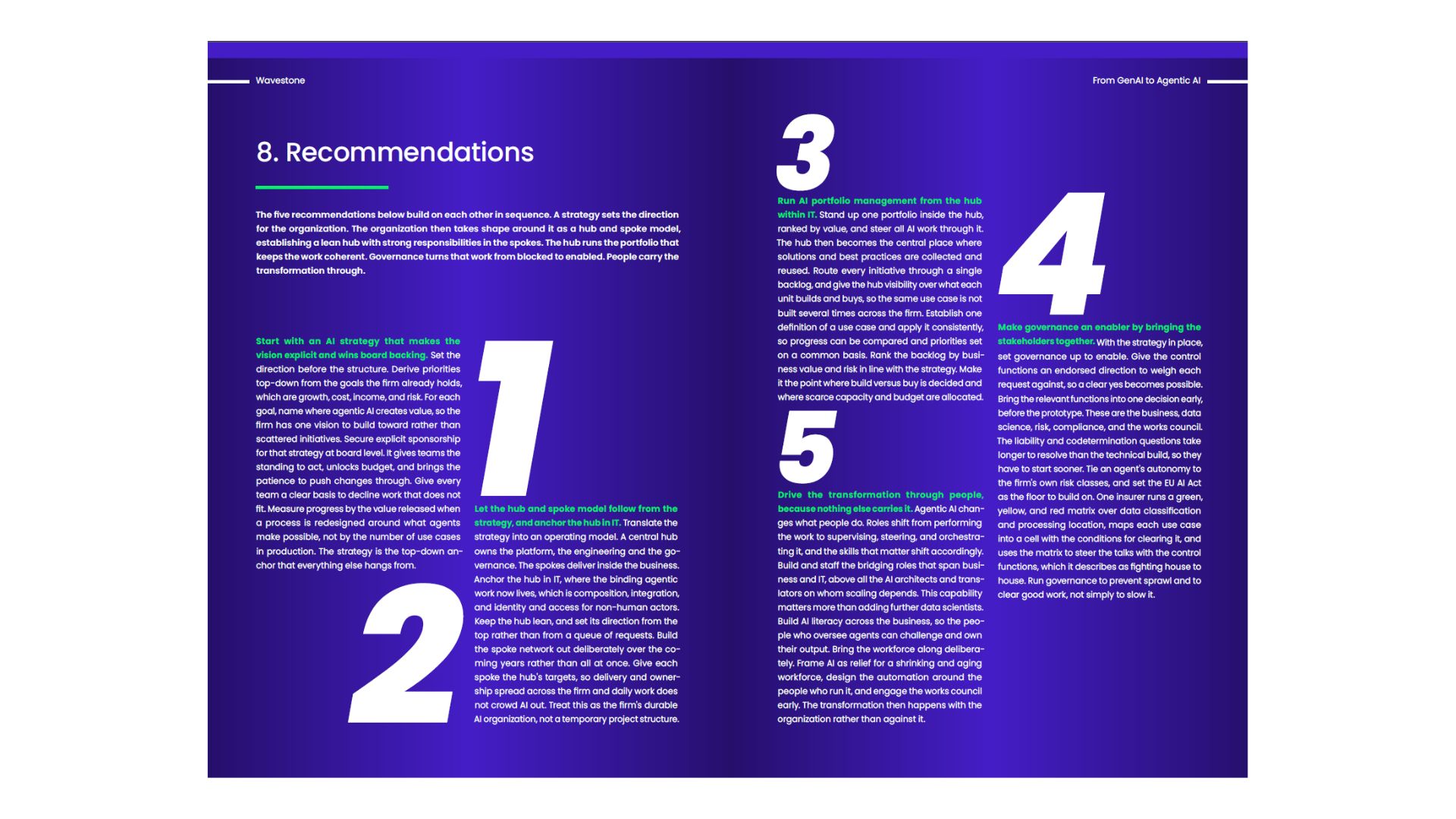
- Recommendations: Practical guidance for financial institutions on defining an AI strategy, building the right operating model, establishing enabling governance, managing AI as a portfolio, and preparing the workforce for the transition.
The future of agentic AI in financial services will not be determined by model performance alone. The real differentiator is an organization’s ability to align strategy, governance, data, technology, and people into an operating model that can safely scale AI across the enterprise.
Contributors
-

Prof. Dr. Jan Marco Leimeister
Managing Director of the Institute of Information Systems and Digital Business
University of St. Gallen
LinkedIn -

Prof. Dr. Mahei Manhai Li
Assistant Professor for Management of Generative und Agentic AI in Organizations
University of St. Gallen, Switzerland
LinkedIn -

Teresa Grauer
Associated research assistant at the Institute of Information Systems and Digital Business
University of St. Gallen, Switzerland.
LinkedIn

