Customer Centricity Study 2026: How insurers can build trust
Published July 7, 2026
- Insurance
- Customer Experience

A data-driven view on post-sale communication, hybrid interaction, and AI adoption
How do customers really want to interact with insurers after the sale?
The Customer Centricity Study 2026 answers this question based on a large-scale, cross-market analysis. It examines communication preferences across customer segments, products, and post-sale use cases.
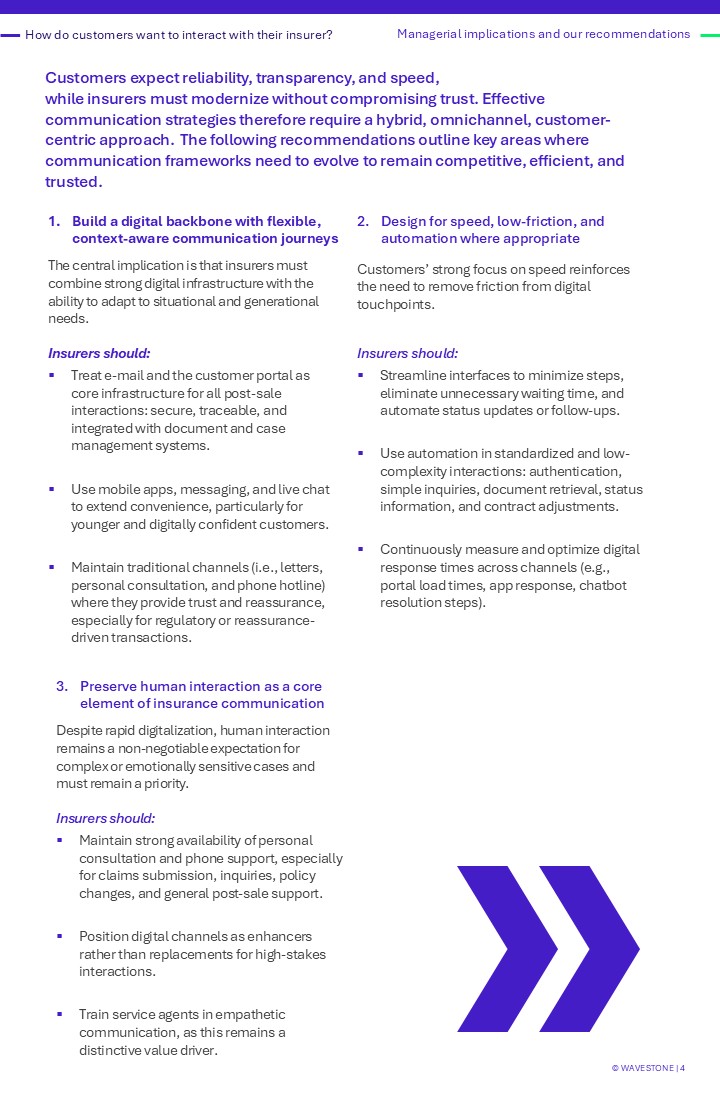
The implication is clear: insurers must orchestrate hybrid communication journeys instead of replacing channels.
A clear customer interaction strategy and seamless information flow between digital and physical channels are essential to create a consistent customer and advisor journey without information asymmetries.
Download now to access the full report and discover how insurers can align communication design with real customer expectations across channels, segments, and post-sale use cases.
Customer Centricity Study 2026:
Inside the study
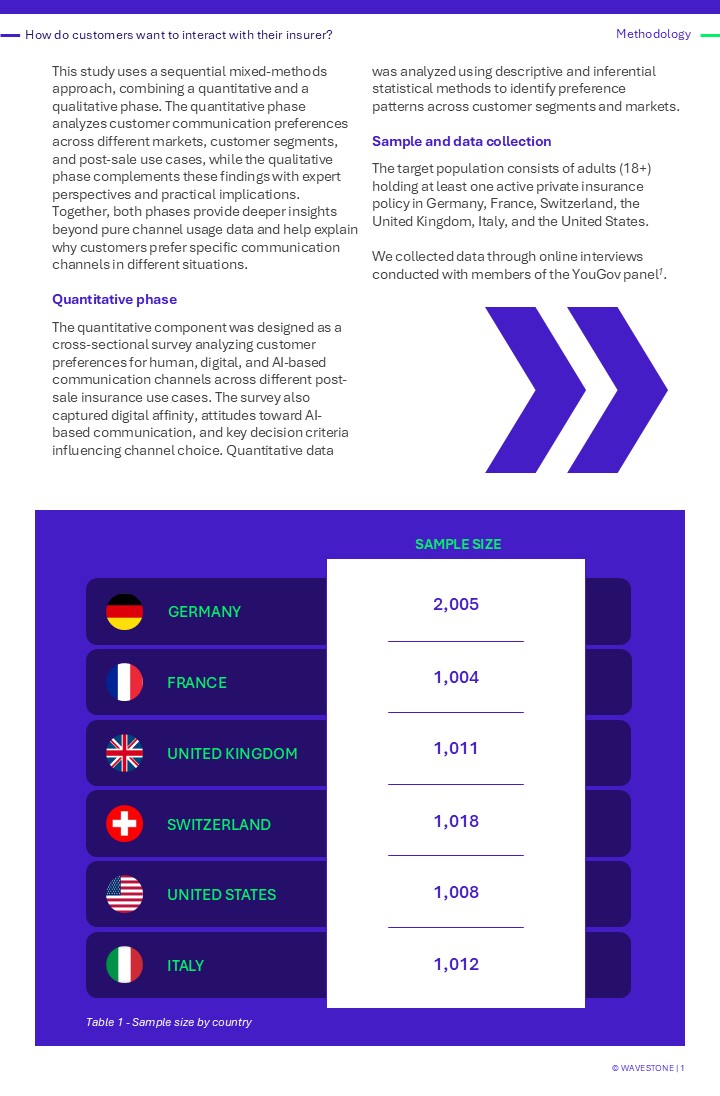
7,000+ insured customers. 6 countries. 7 expert interviews. One clear message.
The Wavestone Customer Centricity Study 2026 reveals exactly how customers want to communicate with insurers across the post-sale journey -from routine policy updates to complex claims. Discover where digital efficiency works, where human interaction remains essential, and how AI can build trust rather than erode it.
Key takeaways
| Post-sale communication is trust-critical, not purely transactional |
Customers choose channels based on risk, complexity and emotional relevance. |
|---|---|
| Digital channels need orchestration, not replacement logic |
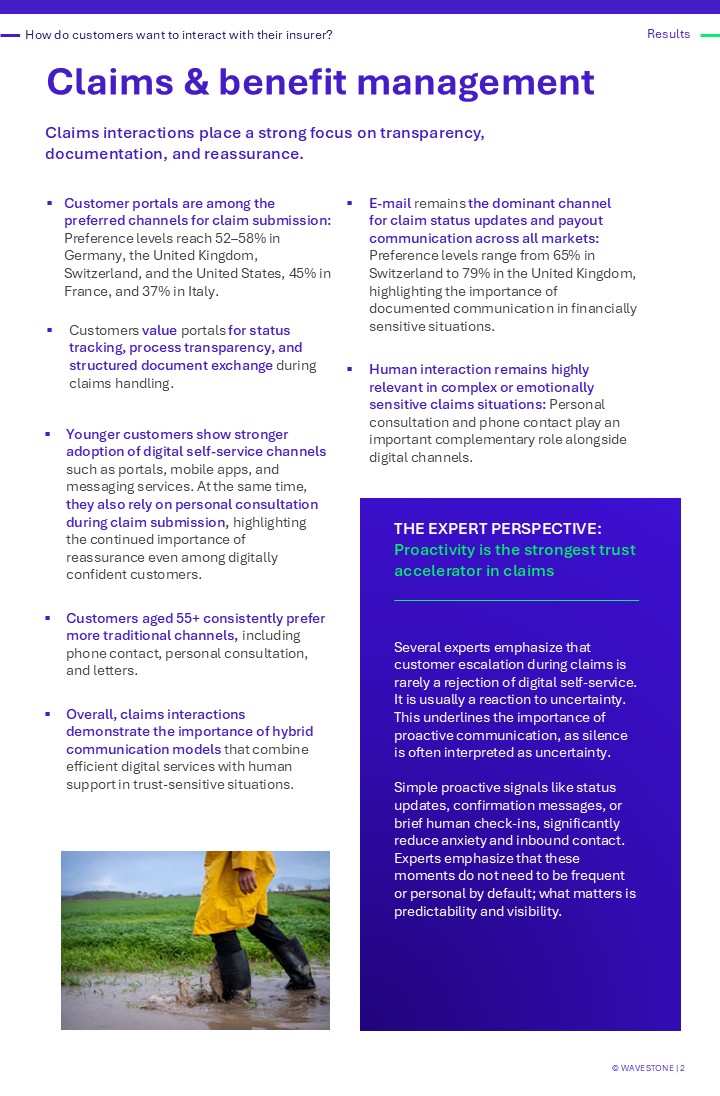
E-mail remains the backbone, while portals, apps, phone and personal consultation each serve distinct roles. |
| AI acceptance depends on transparency and escalation |
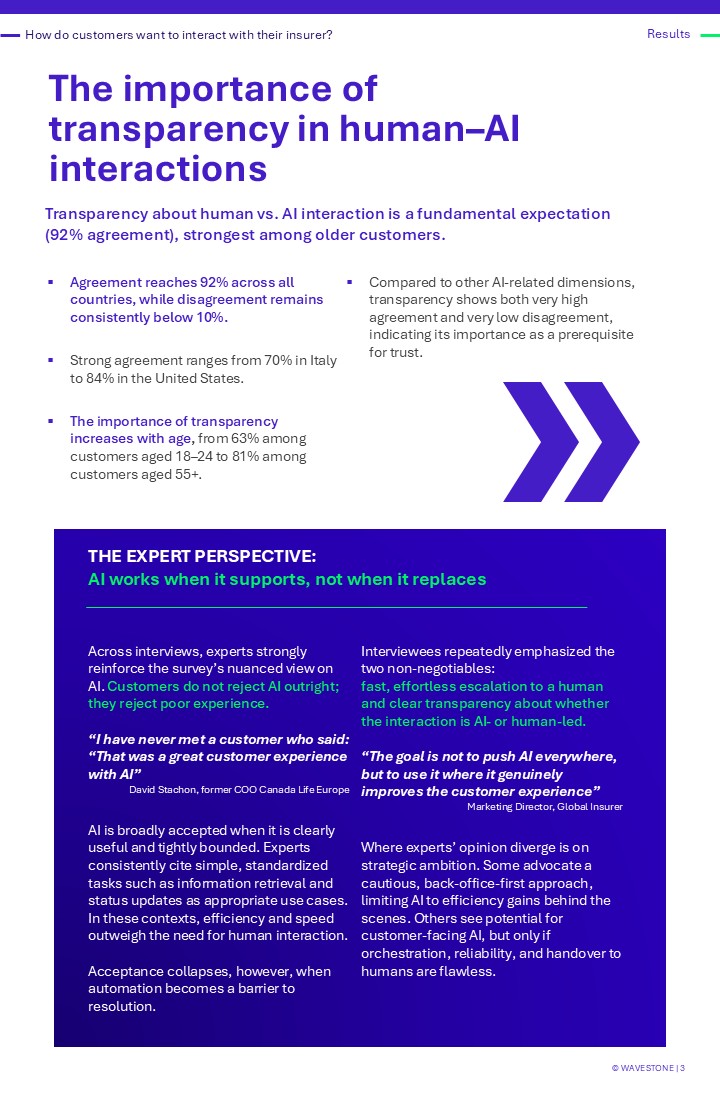
Customers accept AI when it is useful, clearly disclosed and connected to fast human support. |
| Context matters more than demographics |
Age influences intensity of channel use, but needs converge when interactions become consequential. |
| Future advantage comes from trusted orchestration |
Insurers can create value by combining digital efficiency, human expertise and AI designed around transparency, escalation and trust. |
Get a glance at the
Customer Centricity Study 2026
Structure of the study
The CX Study is structured along key phases that reflect how insurers can turn customer insights into communication excellence:
- Management summary: A high-level overview of post-sale customer interaction.
- Study design & methodology: Quantitative insights from 7,000+ participants across 6 markets, backed by qualitative expert interviews.
- Customer behavior deep-dive: Analysis of communication preferences by customer segment and insurance product.
- Post-sale journey analysis: A detailed breakdown of channels across key use cases (claims, support, policy updates).
- AI & technology acceptance: Customer openness toward chatbots, voicebots, automation, and smart services.
The study makes one thing clear: communication excellence does not come from replacing channels or automating everything. It comes from orchestrating the right mix of digital, human, and AI-supported interactions across the customer journey.
Contact us
-

Thorsten Schrader
Partner - Germany, Munich
Wavestone
View more -

Wavestone
View more -

Andolina Rossella
Managing Consultant - Milano
Wavestone
View more -

Sandra Jäger-Pötzke
Managing Consultant - Hamburg
Wavestone
View more -

Saskia Jung
Managing Consultant - Frankfurt am Main
Wavestone
View more -

Anja Merkau
Senior Consultant - Hamburg
Wavestone
View more